



Description
The Ultimate Educational Prototyping System for Mastering Combinational and Sequential Logic
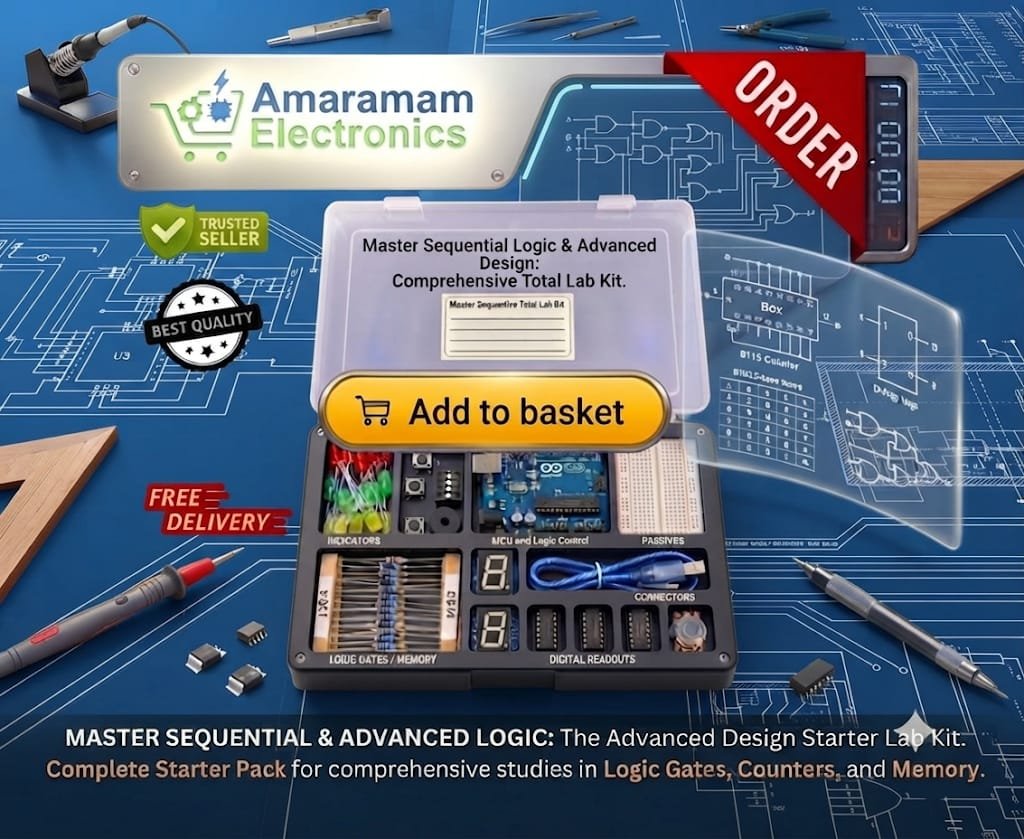
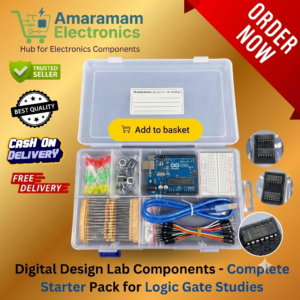
Take your understanding of computer hardware to the next level with the Advanced Digital Design & Sequential Logic Kit by Amaramam Electronics. Designed for engineering students, educators, and serious electronics hobbyists, this comprehensive package bridges the gap between simple binary logic and complex, memory-based digital systems.
While basic kits stop at simple AND/OR gates, this advanced lab kit introduces the foundational building blocks of modern computing: Sequential Logic. Equipped with D-type flip-flops, shift registers, and line decoders, learners can move beyond static truth tables and start building circuits that possess memory, count numbers, and route data.
Coupled with an Arduino Uno compatible microcontroller, a 7-segment display, and an array of tactile inputs like a 4-position DIP switch, this kit provides a complete, hands-on laboratory experience. Whether you are verifying Boolean algebra theorems, designing digital clocks, or building automated alarm systems, this plug-and-play prototyping kit contains everything you need to bring theoretical textbook concepts to life without ever needing a soldering iron.
⚙️ Complete Kit Component List
This kit includes over 100 individual parts, carefully curated to support a full semester’s worth of digital logic and embedded systems experiments.
| S.No | Component | Quantity | Category / Lab Purpose |
| 1 | Arduino Uno DIP (Compatible) | 1 | Microcontroller / Signal Generator |
| 2 | GL12/MB102 Breadboard (830 Points) | 1 | Solderless Prototyping |
| 3 | USB Type-A to Type-B Cable (1 Meter) | 1 | Power & Data Cable |
| 4 | Male-to-Male Jumper Wires | 1 Pack (40 Pcs) | Interconnections |
| 5 | Red, Green & Yellow LEDs | 12 (4 of each) | Output Indicators |
| 6 | 4-Position DIP Switch Module | 1 | 4-Bit Binary Inputs |
| 7 | Push Buttons | 4 | Pulse / Clock Inputs |
| 8 | 220Ω & 330Ω Resistors | 20 (10 of each) | LED Current Limiting |
| 9 | 1kΩ & 10kΩ Resistors | 20 (10 of each) | Pull-up / Pull-down |
| 10 | 74HC00 Quad 2-Input NAND Gate IC | 1 | Universal Logic |
| 11 | 74HC04 Hex Inverter (NOT Gate) IC | 1 | Signal Inversion |
| 12 | 74HC08 Quad 2-Input AND Gate IC | 1 | Combinational Logic |
| 13 | 74HC32 Quad 2-Input OR Gate IC | 1 | Combinational Logic |
| 14 | 74HC86 Quad 2-Input XOR Gate IC | 1 | Adders & Comparators |
| 15 | 74HC74 Dual D Flip-Flop IC | 1 | NEW: Memory & Sequential Logic |
| 16 | 74HC595 8-Bit Shift Register IC | 1 | NEW: Serial-to-Parallel Conversion |
| 17 | 74HC138 3-to-8 Line Decoder IC | 1 | NEW: Address Decoding & MUX Labs |
| 18 | 0.56″ 7-Segment LED Display (Common Cathode) | 1 | NEW: Numerical Output |
| 19 | Active Piezo Buzzer (5V) | 1 | NEW: Audio Alarms / Logic Feedback |
| 20 | 10kΩ Rotary Potentiometer | 1 | NEW: Variable Input Tuning |
💡 What You Will Learn
This kit is perfectly aligned with university-level Computer Science and Electronics Engineering syllabi. By completing experiments with this kit, users will master:
-
Combinational Logic Design: Constructing half-adders, full-adders, and parity checkers using standard 74HC series gates.
-
Memory & State Machines: Understanding how flip-flops store binary states and create sequential circuits.
-
Data Decoding & Routing: Using decoders and multiplexers to route signals, simulating how a CPU selects memory addresses.
-
Binary Output Display: Interfacing logic circuits with 7-segment displays to translate machine code into readable decimal numbers.
-
Microcontroller Integration: Programming an Arduino to generate clock pulses, read shift registers, and automate digital circuits.
🚀 Exciting Example Projects You Can Build
-
Digital Binary Counter: Use the D-Flip Flops and 7-Segment Display to build a circuit that automatically counts from 0 to 9.
-
Shift Register LED Chaser: Program the Arduino and the 74HC595 to create complex, sweeping light patterns using only 3 data pins.
-
Electronic Voting Machine: Use the 4-position DIP switch and logic gates to create a system that calculates a majority vote and sounds the buzzer upon a tie.
-
4-Bit Security PIN System: Design a hardware-level lock that only activates a green LED when the exact correct sequence of binary inputs is entered.




Reviews
There are no reviews yet.