

Description
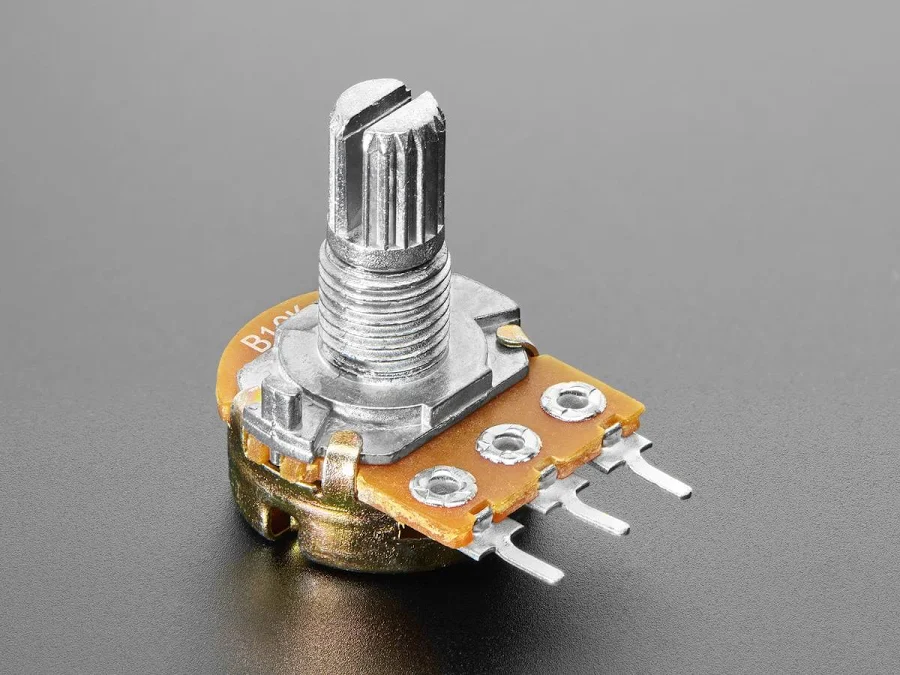
A 10k Ohm Linear Potentiometer is a three-terminal variable resistor widely used in electronics to manually adjust voltage levels, calibrate circuits, or provide user input (such as knobs or dials).
Key Features & Specifications
-
Resistance Value: (10,000 ohms total resistance across the track).
-
Electrical Taper: Linear (B-taper) — meaning the resistance changes in direct proportion to the physical rotation or movement of the shaft, ensuring a uniform voltage divider output.
-
Pin Configuration: Typically features 3 terminals:
-
Outer Pins: Connected across the fixed resistive element (e.g., connected between and Ground).
-
Center Pin (Wiper): Delivers the variable output voltage that changes as the shaft is turned.
-
-
Mounting Options: Available in rotary panel-mount styles (with a threaded bushing and nut for project enclosures) or PCB/breadboard-friendly trimmer (preset) styles.
-
Power Rating: Typically ranges from to for standard carbon or conductive plastic film types.
Common Applications
-
Microcontroller Inputs: Providing analog control signals to ADCs (Analog-to-Digital Converters) on development boards like the STM32 or Arduino.
-
Voltage Dividers: Creating adjustable reference voltages for sensor circuits or operational amplifiers.
-
Calibration: Trimmer potentiometers are often used for “set-and-forget” circuit adjustments during prototyping.
Usage Tips
-
Linear vs. Logarithmic: Ensure you use a Linear (B) taper for electronics and microcontroller control. Logarithmic (A) tapers are built for audio volume control and will feel nonlinear when read by an ADC.
-
Pull-down stability: When wiring it as a voltage divider, always connect the outer pins to your power rail and ground, and route the center wiper directly to your microcontroller’s analog pin.

Reviews
There are no reviews yet.